22/10/2026 19:58
Can Others Continue Your Wrapping Demo? TikTok Stitch Permissions for Cambodian Gift Shops

A wrapping demonstration can leave viewers with a practical question: can they reproduce that neat corner on their own box? For a Cambodian gift shop, inviting a video response can make that question useful. It can also expose a customer's personalised gift or circulate a technique without the explanation that makes it understandable. Before promoting the post or reviewing an SMM panel catalogue, decide which part of the demonstration you are comfortable letting others reuse. This workflow follows a hypothetical Phnom Penh gift-wrapping shop preparing a simple paper-folding invitation. The aim is to encourage relevant participation, preserve context and give genuine buyers a clear route to ask for a quote.
1. Give the response a practical purpose
TikTok describes Stitch as a way to combine part of an existing video with a new creation. For this shop, the useful possibility is a sequence: the shop demonstrates a corner fold, then another person shows their attempt or explains where it becomes difficult. TikTok's introduction to Stitch also describes attribution linking back to the original video. That connection provides context; it does not make the responding creator a customer or an endorsed partner.
Choose one question before filming. In this hypothetical example, the question is whether viewers can keep the paper corner flat around a small rectangular box. Avoid asking people to show an entire wrapping routine, choose ribbon, discuss prices and recommend the shop in one response. A narrow invitation gives the shop something concrete to examine. If the real objective is receiving orders for an upcoming celebration, a direct enquiry post may serve that purpose better than a creative participation exercise.
2. Decide which demonstration belongs in public reuse
Separate a teaching sample from a live customer job. Use an empty box, ordinary paper and a neutral ribbon. Remove gift messages, delivery labels, receipts, customer photographs and distinctive personalisation from the filming table. A demonstration prepared specifically for public reuse is easier to assess than footage captured while packing several real orders. Ask the person appearing in the clip whether they are comfortable with excerpts being used in other people's videos.
Apply a simple decision test: would this moment still make sense if someone saw it without the rest of the demonstration? A close view of a fold may pass. A sentence promising that every object can be wrapped this way probably fails. So might an unfinished customer design that needs private approval. If the clip requires confidential context, film a separate sample. Disabling reuse is a setting choice, but removing sensitive material before filming is a stronger editorial habit.
3. Film an excerpt that carries its own meaning
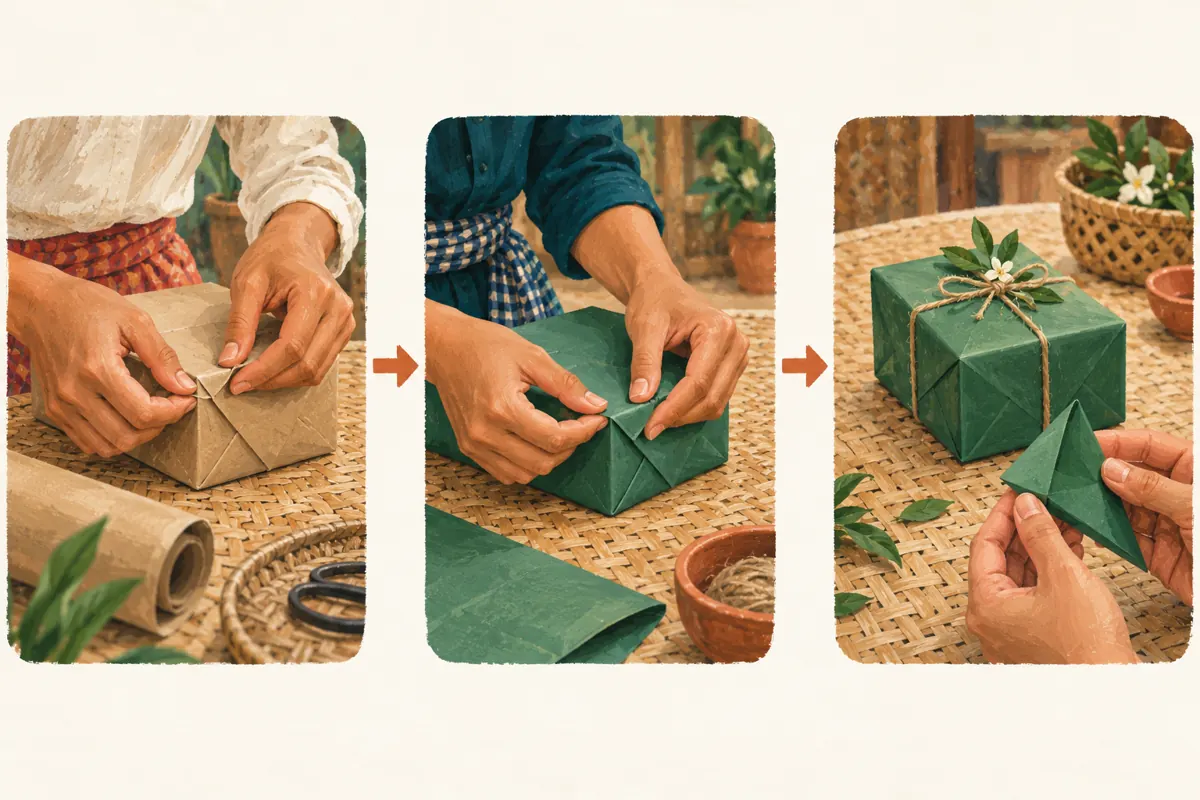
Build the demonstration around a visible action rather than a long introduction. Show the box shape, the paper edge and the hand movement that creates the corner. Keep the camera steady enough that viewers can distinguish the first fold from the final tuck. Leave tools in consistent positions between takes. A sudden change of paper or box can make an ordinary edit look like a missing instruction.
For Cambodian viewers who use Khmer, prepare a clear Khmer explanation and have a fluent colleague check the meaning. Keep any English product terms only where they help identify the material. Explain limitations beside the relevant action: this example uses a rectangular box and flexible wrapping paper. Do not bury that information after the invitation. Watch the excerpt without sound as an additional clarity check. If the hand position is impossible to follow, improve the framing rather than expecting a caption to repair it.
4. Check both the account and the individual post
TikTok's Stitch privacy help says a public account is required. In Profile, open Menu, Settings and privacy, Privacy, then Reuse of content. Under Allow reuse of content from, the documented choices are Everyone or Friends, meaning followers you follow back. Choose deliberately rather than assuming every viewer has the same permission.
For a new post, check More options and Allow reuse of content. For an existing video, look under its More options and Privacy settings. TikTok notes that this shared setting also affects Duet, stickers and adding the post to Stories. Review those consequences before changing it.
Record the shop's choice beside the approved video reference. Have a colleague check the published invitation from an appropriate viewer account without posting anything. If the expected option is absent, review the actual account and post settings before advertising participation. Keep the test observational; nobody needs the shop owner's password.
5. Write an invitation that explains the response
A hypothetical invitation could say: show your attempt at this corner fold and explain where the paper bunches. Add a reminder to use a sample box without names or addresses. This gives participants a task and tells the shop what kind of reply would help. It also leaves room for imperfect attempts, which can reveal an unclear demonstration more usefully than polished praise.
Keep the commercial next step separate and brief. For example, tell people who want wrapping help to send the box dimensions, quantity and required pickup date through the shop's stated enquiry channel. Do not require a public video before answering a buying question. Someone ordering gifts for colleagues may have a practical deadline and no interest in recording themselves. Make both routes understandable: participation helps discuss the technique, while an enquiry begins a conversation about the work.
6. Prepare the staff response before inviting participation
Assign one person to review responses and one person to confirm quotes, even if both roles belong to the owner. Prepare useful replies for predictable problems: paper cut too short, a corner folded in the wrong direction or a box shape unlike the sample. Keep advice tied to what is visible. If the material cannot be identified from the video, ask instead of asserting that the participant used the wrong paper.
Agree on a modest review routine that fits the shop's workload. Check responses between packing sessions and save recurring questions for a future demonstration. Do not promise personal instruction to everyone unless staff can provide it. If someone asks about service availability in Siem Reap while the shop only offers Phnom Penh pickup, explain the actual arrangement. A shared language or an apparently local profile does not establish the person's location or the shop's ability to fulfil their request.
7. Keep SMM catalogue labels separate from the creative task
A relevant public catalogue label in the supplied khmer-social.com brief is “TikTok - Share ~ Max 1M ~ 𝗥𝗘𝗙𝗜𝗟𝗟 30D ~ 500k/days ~ INSTANT”. The name identifies a share-labelled listing, but its supplied description is empty. It provides no supported explanation of delivery mechanics, participant consent, Cambodian audience relevance or Stitch creation. The quantity, speed and refill language inside the name should not be treated as independently verified performance.
A share-labelled service is not evidence that someone watched carefully, attempted a fold or requested a quote. Purchased engagement also cannot establish genuine interest, sales, ad delivery or Cambodian users. TikTok's Community Guidelines prohibit services that artificially boost engagement or manipulate its recommendation system. Do not use purchased activity to seed apparent enthusiasm for this invitation. For an SMM panel customer, the useful decision here may be to pause the proposed order and spend the effort on a clearer demonstration and staffed replies.

8. Review responses without turning them into testimonials
Keep three categories in a simple review note: creative responses, buying questions and confirmed work. A video showing a different folding method belongs in the first category. A message asking whether the shop can wrap a particular box belongs in the second. Only the shop's normal confirmation process moves a request into the third. Record the content reference and the question answered, rather than collecting unnecessary personal details.
In a hypothetical review, several people might discuss the paper while nobody asks for paid wrapping. That would suggest the demonstration prompted a craft conversation; it would not establish a sales result. Conversely, a useful private enquiry may arrive without a public response. Ask how the person found the shop when appropriate, and preserve uncertainty if they cannot remember. Before featuring a participant in a separate promotional post, obtain permission and describe their contribution accurately. An attempt at a fold is not a customer recommendation.
9. Catch the mistakes that change the meaning
One common mistake is showing a finished decorative box while the invitation refers to a corner fold that is barely visible. Another is asking for broad participation while the permitted audience is narrower than intended. A third is leaving a temporary pickup promise inside an otherwise reusable demonstration. Review the visual action, permission choice and commercial wording together so that the invitation matches what viewers can actually do.
Avoid calling every critical response harmful. Someone showing that the technique fails on thick paper may have identified a real limitation worth explaining. Respond to the material and method rather than pressuring the person to praise the shop. If a response contains a genuine privacy or policy concern, preserve the relevant reference and use the appropriate platform reporting route. Keep a factual correction separate from a sales pitch; otherwise, a helpful clarification can look like an attempt to avoid the question.
10. Make the next demonstration better
End the review with one editorial decision. If viewers repeatedly miss the initial crease, film that action closer. If they use cylindrical containers, prepare a separate demonstration instead of stretching the rectangular-box explanation. If the invitation is clear but staff cannot answer responses promptly, reduce the scope of the next exercise. These are practical changes supported by observed questions, without assuming a platform distribution effect.
Keep the original recording, approved caption, public reference and short review note together. Record changes to permissions so another staff member does not unknowingly reopen reuse. Preserve a clean master without customer information for future teaching. For a Cambodian shop preparing seasonal gift work, this small record helps distinguish a reusable craft lesson from an offer tied to current materials, capacity and pickup arrangements. The next promotion can then build on a specific lesson instead of repeating the same invitation.
Frequently asked questions
Should every gift-wrapping video allow Stitch?
No. Decide according to the material and purpose. A neutral teaching sample may suit a response invitation. A personalised commission, customer surprise or design awaiting approval may not. Even for a teaching sample, consider whether an isolated excerpt could misrepresent the method or reveal something that should stay private.
What if people want help but cannot make a Stitch?
Offer another way to ask the question, such as the shop's normal enquiry channel. Request only the information needed to help: box shape, material and the point where the fold becomes difficult. Do not ask viewers to bypass another creator's permissions or send account credentials to troubleshoot participation.
Does changing reuse permissions remove associated videos?
Do not confuse permission changes with deletion. TikTok documents a separate Reuse of content history tool. Its Remove all posts action permanently removes the original post and associated Duet and Stitch videos. Read the confirmation carefully and preserve your original recording before considering that action.
Can the shop share a useful response as proof of satisfied customers?
Only describe what the response actually establishes. A person demonstrating a fold may never have purchased anything. Ask permission before using their contribution in a separate promotion, and label it as a participant's demonstration if that is what it is. Do not convert craft participation into a testimonial.
What is a sensible result to report after this exercise?
Report the questions received, the explanation improved and any independently confirmed enquiries or orders. State uncertainty about attribution. If the main discovery is that viewers need a clearer view of the first crease, that is a useful editorial finding. Neither a public response nor a panel delivery record proves commercial success.
Explore the current service catalogue, create an account, or ask a specific question through support tickets.
- TikTok Newsroom: New on TikTok — Introducing Stitch
- TikTok Help Center: Stitch privacy settings
- TikTok Community Guidelines
Prepared with AI assistance. Illustrations explain the workflow and do not represent customer results.